

Recovery That Meets You Where You Are
Whether you're reaching out for yourself, someone you care about, or a client in need of support, Cenikor is here to help you take the next step. With flexible, evidence-based care and a commitment to serving everyone, we make recovery more accessible—and more sustainable.
Start the ConversationKey Takeaways
- First-time use of cannabis, cocaine, LSD, and ecstasy skews toward summer months, with initiation rates running above the 25% baseline you’d expect from an even seasonal split.1
- Summer raises risk because the guardrails that shape a school Tuesday — structure, supervision, homework, bedtime — drop away at once, opening room for unstructured time, peer exposure, and unfamiliar cash from a first job.
- A 90-day playbook works best: set specific rules about location, company, and rides in early June; coordinate with other parents through July; and use late August for a real reentry check-in.6,10
- If you find a vape, pills, or a pattern rather than a one-off, wait a night, lead with a question instead of an accusation, and consider a professional assessment when use is escalating or involves unknown pills.10,2
The short answer parents came here for
Yes. If you’re asking whether teen substance use tends to spike in the summer, the honest answer is that first-time use does climb during June and July, and the pattern is well-documented enough that you should trust your instinct to pay closer attention right now.7
Here’s what that actually means for you, sitting at your kitchen table worried about your kid: summer isn’t a curse, and most teens will get through it fine. But the conditions that shape summer — long empty afternoons, sleepovers without a school night in the way, pool parties, road trips, a first job with cash in the pocket — line up in a way that gives a teen more chances to try something for the first time. That’s not fear-mongering. That’s just the shape of the season.
If your gut has been telling you something is off, that instinct matters. And if you’re just planning ahead before the school year ends, that instinct matters too. This guide gives you the numbers, the mechanisms, the warning signs worth watching, a week-by-week playbook, and a clear picture of what to do — including when to call someone like Cenikor — if you’re already past the prevention stage.
What the research actually says about summer initiation
You don’t need to guess at whether summer changes the odds. Researchers have measured it, and the pattern shows up across different substances and different datasets.
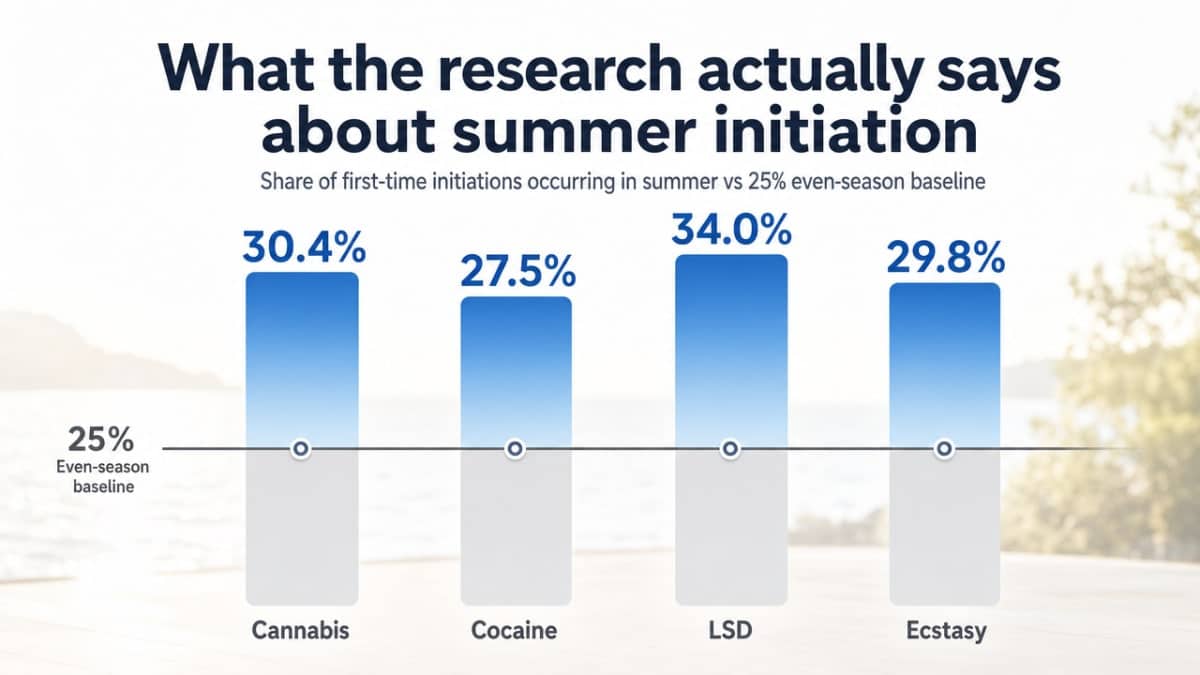
A peer-reviewed analysis of national survey data found that first-time use of several drugs was significantly more likely to happen in summer than in any other season. Specifically:1
- 30.4% of cannabis initiations occurred during summer months
- 27.5% of cocaine initiations occurred during summer months
- 34.0% of LSD initiations occurred during summer months
- 29.8% of ecstasy initiations occurred during summer months
Since summer is only one of four seasons, an even distribution would put each around 25%. The lift above that baseline is what tells you something real is happening — teens who are going to try one of these substances for the first time are meaningfully more likely to do it between June and August.
A couple of honest caveats belong right here, because you deserve them. The seasonal differences the researchers found are real but modest, and they rely partly on people remembering when they first tried something, which is imperfect. The authors themselves recommend treating prevention as a year-round job rather than something you only turn on in June. So the point isn’t to panic in May and relax in September. It’s to know that the window you’re worried about has data behind it.1
There’s also a broader piece of context worth holding alongside these numbers: a 2024 pediatric emergency department study found that 38.2% of 14–17-year-olds and 67.4% of 18–21-year-olds reported past-year substance use. Those aren’t summer-specific figures, but they tell you that use among older teens and young adults is common enough that waiting for a crisis to start paying attention is not a strategy. The seasonal spike is a reason to lean in. The overall prevalence is a reason not to assume it can’t be your kid.2
Why summer specifically raises the risk
The season itself isn’t the problem. What summer does is remove the guardrails that quietly keep a teen’s day on rails for nine months of the year, and it does that all at once.
Think about what a school Tuesday looks like: a fixed wake-up time, six or seven hours where adults know exactly where your kid is, a coach or a teacher who notices if something seems off, homework that fills the evening, and a bedtime driven by the next morning. Now take all of that away. What you have left is a long, warm afternoon with friends, no attendance sheet, and a phone that can arrange almost anything.
SAMHSA’s monthly analysis of national survey data found that first-time use of most substances peaks during June and July, with a higher average number of youth initiating substances per day in summer than in any other stretch of the year. That’s the pattern behind the anxiety — more kids trying something for the first time on any given June or July day than on a comparable day in November or February.7
A few specific summer conditions do most of the work:
- Unstructured time is the biggest one — teens have more empty hours and more say over how those hours get filled.
- Peer exposure goes up because friend groups mix at parties, pools, and lake days that don’t happen during a school week.
- Adult supervision drops when both parents are working through the summer and the kid is home, or when sleepovers stretch across weeknights that used to be off-limits.
- Money shifts. A first summer job puts unfamiliar cash in a pocket that used to be empty.
None of that means your teen will use. It means the odds shift, and the shift is measurable. Knowing why helps you decide where to put your attention — not everywhere at once, but at the specific pressure points where the season does its work.
The nuance most articles skip: summer is not universally the worst season
Here’s something you probably won’t see in the panicky headlines: summer isn’t the peak for every teen crisis. A CDC MMWR analysis of emergency department visits from 2018 through mid-2023 found that ED visits for several mental and behavioral health conditions among children and adolescents were actually higher during school semesters than during the corresponding summer weeks. School stress, social pressure, and the sheer density of the academic year drive their own kind of harm.19
So what does that mean for you? It means the story is more specific than “summer bad, school year safe.” Summer is when first-time use tends to climb, because that’s when the guardrails come off and curiosity meets opportunity. The school year carries different pressures that show up in different data. Both windows matter, and pretending otherwise sets you up to either overreact in June or under-react in October.
The practical version: treat summer as a heightened-vigilance window for initiation and peer-driven experimentation, and keep the same eyes open in the fall for stress-driven use. You’re not choosing which season to worry about. You’re just learning what each one tends to bring.
Warning signs that deserve a second look
Warning signs rarely arrive as a dramatic single moment. They show up as a drift — a series of small changes that each feel explainable on their own but start to add up when you line them up.
Here’s what’s worth a second look during a summer stretch:
- A sudden shift in the friend group, especially if the new circle is older or vaguer about where they hang out.
- A new smell in the car, on a hoodie, or in a bedroom that lingers even after a window’s been open.
- Eyes that look different — glassy, red, or heavy — at pickup or after a sleepover.
- Sleep that flips: your kid is up until 4 a.m. and asleep until 2 p.m., not because summer, but because their whole rhythm has moved.
- Money that disappears faster than a first job explains, or small amounts of cash missing from your wallet.
- Vape cartridges, empty mini bottles, foil, pill fragments, or lighters where lighters don’t belong.
- A door that used to stay open and now stays locked.
None of these on their own means your teen is using. Teens go through real developmental changes that look like some of this list. What you’re watching for is a cluster — three or four of these arriving in the same few weeks, alongside a shift in mood, grades slipping in summer coursework, or a pulling-away from activities they used to care about. Federal parent guidance is explicit that these small signals are worth a conversation rather than a wait-and-see, and that catching a pattern early beats catching it late.10
If your gut says look again, look again. You’re not being paranoid. You’re paying attention, and that’s exactly the job right now.
A 90-day summer playbook for parents
Early June: set the frame before the first pool party
The first two weeks after school lets out are your setup window. Not your lecture window — your setup window. What you say and do now shapes how the next ten weeks feel for both of you.
Start with one honest conversation, not a speech. Sit down somewhere that isn’t the kitchen island at 9 p.m. and say what you actually want to say: you’re glad summer’s here, you know things are going to loosen up, and you want to agree on a few ground rules before the first party lands. Federal parent guidance is clear that talking directly, early, and without shame works better than waiting for a problem to surface.10
Get specific about three things: where they’ll be, who they’ll be with, and how they’ll get home. Ask for a text when plans change, not a text after. Decide together what happens if they need a ride out of a situation at midnight — a no-questions pickup is one of the single most protective agreements you can make.
You just built the frame. That’s a win worth counting.
Mid-summer: sleepovers, road trips, and first-job cash
By early July, the setup phase is over and real life is testing everything you agreed to. This is the stretch where most unstructured risk lives, and it’s where NIAAA’s core parenting advice earns its keep — talk early and often, be consistent with the rules you set, and coordinate with other parents about where kids actually gather.6
Sleepovers. Call the other parent. Not to interrogate — just to confirm an adult is home, that you’re on the same page about alcohol, and that phones aren’t disappearing into a bowl for the night. If you can’t reach a parent, that’s your answer.
Road trips and lake days. Get the itinerary in writing, even if it’s a text thread. Know who’s driving, what time they’re coming back, and whether any part of the day involves a house you haven’t heard of. Trust the plan more than the promise.
First-job cash. Sudden money is one of the quiet risk multipliers of summer. Help your teen open a checking account, ask about spending in a curious tone rather than a suspicious one, and notice if cash keeps disappearing without anything to show for it.
One more non-negotiable: don’t serve alcohol to your teen’s friends, and don’t look the other way when another adult does. CDC guidance is direct — adults should not give or serve alcohol to anyone younger than 21, period. It matters more than you think.14
Late August: the back-to-school reentry check-in
The last two weeks before classes start are quieter than mid-July, but they matter as much. Reentry is when a summer of small changes either gets integrated back into a school-year rhythm or gets buried under new homework and forgotten.
Take a walk together, or a car ride — somewhere with a little motion so eye contact isn’t constant. Ask what surprised them about the summer. Ask who they got closer to and who they drifted from. You’ll learn more from those two questions than from any direct interrogation about substances.
Then look at the practical side. Reset bedtimes a week before school starts, not the night before. Put phones out of bedrooms again if that rule slid. Notice any friend group changes that are carrying into the fall.
If something felt off this summer and you never quite figured out what, this is the moment to say so out loud. Not as an accusation — as a check-in from someone who’s paying attention. That’s exactly what protective parenting research points to as one of the strongest things you can do.11

The pre-college summer is its own risk category
If you have a graduating senior, the summer between high school and college deserves its own conversation. It isn’t just a longer version of a regular summer. It’s a hand-off — from a house where you set the rules to a dorm where nobody does — and the data shows that hand-off starts before move-in day.
SAMHSA’s analysis of full-time college students found monthly peaks in first-time use of alcohol, marijuana, and inhalants during the summer months, with underage drinking initiation peaking specifically in June. Read that carefully: the peak isn’t during orientation in August or the first party in September. It’s in June, while your kid is still technically living under your roof, celebrating graduation, going to bonfires with a class they’ll never sit with again.8
What’s driving it is a mix of things — permission-slip energy (“I’m basically an adult now”), friend groups scattering and wanting one last summer, and a sense that whatever happens now doesn’t count against the school year that just ended or the one that hasn’t started. It counts.
Your job in this window is different from mid-summer parenting. You’re not just setting rules; you’re coaching for the environment they’re about to walk into. Talk about what they’ll do if a roommate drinks nightly. Agree on a check-in rhythm that survives the move. And keep talking through August — the setup you build now is what they carry into a dorm room where you won’t be down the hall.
If you already found something: what to do this week
First: breathe. Finding a vape in a backpack or catching the smell of alcohol on a hoodie is scary, and the fear you’re feeling right now is the right feeling. It doesn’t mean you failed. It means you’re paying attention, and paying attention is what changes what happens next.
Don’t confront in the first hour. Take the object, put it somewhere your teen can’t get to it, and give yourself a night to think. A conversation started in panic almost always turns into a fight, and a fight teaches your teen to hide better next time. That’s the opposite of what you want.
When you do talk, lead with a question, not an accusation. “I found this. I need you to help me understand what’s going on” opens a door. “How could you do this?” closes one. Federal parent guidance is direct that staying calm and curious in these moments keeps kids talking. Ask what they used, how often, who was there, and whether anything scared them. Listen more than you correct.10
Then act on what you learn. If it was a one-time experiment at a party, tighten the plan you set in June and follow through. If it’s been going on for weeks, if there are multiple substances, or if you’re finding signs your teen can’t explain, this is the point where a professional assessment matters more than another conversation at home. Call your pediatrician, or call a treatment provider directly. You don’t have to know what level of help your kid needs before you pick up the phone — that’s what the assessment is for.
What treatment can look like when prevention has passed
When a phone call to Cenikor makes sense
You don’t have to wait until things fall apart to call. If the summer surfaced a pattern rather than a one-off — regular use, hiding, use that’s escalating in amount or frequency, mixing substances, or use that’s starting to hurt sleep, grades, mood, or friendships — that’s the point where a professional voice on the phone helps more than another lecture at home.
Call sooner if you’re seeing physical signs you can’t explain, if your teen has tried to stop and can’t, or if there’s any use of opioids, benzodiazepines, or unknown pills from a friend. Given that past-year substance use shows up in a meaningful share of adolescents in clinical settings, asking for an assessment isn’t overreacting — it’s how you find out what you’re actually dealing with.2
From assessment to detox, residential, and MAT
The first call to Cenikor is an assessment, not a commitment. A clinician walks through what your teen is using, how often, what’s happening at home, and what physical or behavioral signs you’re seeing. From there, the recommendation gets specific.
If your teen’s body has grown dependent on alcohol or another substance, medical detox comes first — supervised, staffed around the clock, and designed to get through withdrawal safely rather than white-knuckling it at home. Residential treatment usually follows, giving your teen a stretch of time away from the friend group, the phone, and the summer schedule that shaped the use in the first place. Days are structured around counseling, group work, education, and the rebuilding of a normal routine.
For some teens, especially those who’ve been using opioids, medication-assisted treatment becomes part of the plan. MAT pairs FDA-approved medication with counseling and is not a shortcut — it’s evidence-based care that lowers the odds of relapse while the deeper work is happening. What each teen needs is different, which is exactly what the assessment is built to figure out.
Aftercare and the first sober school year
The stretch that decides whether recovery holds isn’t residential. It’s what happens after — when your teen walks back into a bedroom, a phone, and eventually a hallway full of the same faces they used with.
Aftercare at Cenikor is built for that reentry. Outpatient sessions, recovery coaching, family support, and recovery housing when it fits give your teen scaffolding while the school year rebuilds itself around them. The protective practices researchers point to — steady limits, real monitoring, warm communication — start doing their work again, this time with a treatment team in the mix.11
You’ve been carrying a lot. Getting to the first sober school year is a real milestone, and it’s built one week at a time, not all at once.
If Summer Turned Into Something More, Cenikor’s Odyssey House Is Built for This
Everything in this guide points to the same truth: summer raises the odds, but it doesn’t decide the outcome.What decides the outcome is what happens next, and that’s where a lot of parents feel stuck. You don’t have to figure it out alone. Cenikor’s Odyssey House in Houston is a treatment program built specifically for teens ages 13 to 17. It’s co-ed, and it meets adolescents where they are with medically supervised detox and residential care, backed by psychiatric and primary care on site. That combination matters for teens, because substance use rarely shows up by itself.
Anxiety, trauma, and family stress are often part of the same picture, and Odyssey House is designed to treat the whole person, not just the symptom. Recovery doesn’t stop at discharge. Every teen who completes treatment at Cenikor has access to free recovery support services, including one-on-one coaching and a growing alumni community, for up to two years afterward.
That’s the follow-through that turns a hard summer into a real turning point. There is no shame in reaching out, and no judgment waiting on the other end of the call. If you’re worried about your teen right now, talk to someone who treats adolescents every day.
Connect with us today to get started on a healthier tomorrow.
Frequently Asked Questions
At what age should I start talking to my child about alcohol and drugs?
My teen says everyone drinks at parties. Is it really that big a deal if I let them have a beer at home?
How do I tell the difference between normal teen moodiness and a real warning sign?
What should I do if I find a vape, pills, or paraphernalia in my teen’s room?
How do I know if my teen needs treatment versus just a serious conversation?
Does Cenikor treat teens, and what does the first call look like?
References
- Summer as a Risk Factor for Drug Initiation – PMC. https://pmc.ncbi.nlm.nih.gov/articles/PMC7080950/
- Substance Use among Youth Presenting to the Pediatric Emergency Department. https://pmc.ncbi.nlm.nih.gov/articles/PMC11707121/
- Substance Use Among Youth | Reducing Health Risks. https://www.cdc.gov/youth-behavior/risk-behaviors/substance-use-among-youth.html
- About Underage Drinking | Alcohol Use – CDC. https://www.cdc.gov/alcohol/underage-drinking/index.html
- Get the Facts About Underage Drinking. https://www.niaaa.nih.gov/publications/brochures-and-fact-sheets/underage-drinking
- Parenting To Prevent Childhood Alcohol Use. https://www.niaaa.nih.gov/publications/brochures-and-fact-sheets/parenting-prevent-childhood-alcohol-use
- Monthly Variation in Substance Use Initiation among Adolescents. https://www.samhsa.gov/data/report/nsduh-report-monthly-variation-substance-use-initiation-among-adolescents
- Monthly Variation in Substance Use Initiation Among Full-Time College Students. https://www.samhsa.gov/data/report/monthly-variation-substance-use-initiation-among-full-time-college-students
- CDC Launches New Campaign to Address Youth Substance Use …. https://www.cdc.gov/media/releases/2025/2025-cdc-launches-new-campaign-to-address-youth-substance-use-and-mental-health.html
- Growing Up Drug Free: A Parent’s Guide to Substance Use Prevention. https://www.getsmartaboutdrugs.gov/sites/default/files/2024-08/GUDF_2024_FINAL_508.pdf
- Evidence-Based Interventions for Preventing Substance Use. https://pmc.ncbi.nlm.nih.gov/articles/PMC2916744/
- Risk and Protective Factors and Estimates of Substance Use Initiation. https://www.ncbi.nlm.nih.gov/books/NBK481723/
- Age of Substance Use Initiation Among Treatment Admissions Aged …. https://www.ncbi.nlm.nih.gov/books/NBK384841/
- Preventing Underage Drinking with Community Strategies. https://www.cdc.gov/alcohol/underage-drinking/community-strategies.html
- Monitoring the Future. https://nida.nih.gov/research-topics/trends-statistics/monitoring-future
- Monitoring the Future (MTF) – Health, United States – CDC. https://www.cdc.gov/nchs/hus/sources-definitions/mtf.htm
- Dynamic Patterns of Adolescent Substance Use: Results From a Nationally Representative Sample. https://pmc.ncbi.nlm.nih.gov/articles/PMC4712666/
- A Qualitative Exploration on Risk and Protective Factors of Substance Use among Black High School-aged Adolescent Girls. https://pmc.ncbi.nlm.nih.gov/articles/PMC12002422/
- Seasonal Trends in Emergency Department Visits for Mental and Behavioral Health Conditions Among Children and Adolescents — United States, January 2018–June 2023. https://www.cdc.gov/mmwr/volumes/72/wr/mm7238a3.htm
- Alcohol-Induced Deaths Among Persons Aged 1–19 Years: United States, 2000–2020. https://www.cdc.gov/nchs/products/databriefs/db459.htm
- Prevention Resources for Parents and Guardians. https://www.pa.gov/agencies/ddap/substance-use-prevention/prevention-resources-for-parents-guardians
- Underage Drinking. https://www.cdc.gov/alcohol/fact-sheets/underage-drinking.htm
Recovery Built for Real Life
Recovery doesn't have to feel out of reach. At Cenikor, we provide practical, affordable care designed for real life—whether you're navigating substance use, supporting a loved one, or helping someone find the right level of care.
Explore Your Options Written by Cenikor’s Clinical & Compliance Team