

Recovery That Meets You Where You Are
Whether you're reaching out for yourself, someone you care about, or a client in need of support, Cenikor is here to help you take the next step. With flexible, evidence-based care and a commitment to serving everyone, we make recovery more accessible—and more sustainable.
Start the ConversationKey Takeaways
- Watch for patterns across gatherings, not one rough night, and jot down specific moments, since clinicians diagnose alcohol use disorder only when two or more symptoms occur over time.3
- Make the gathering safer ahead of time with inviting alcohol-free drinks and respect for every “no thanks,” which eases pressure on anyone who is struggling.2
- If your loved one is using at the gathering, redirect quietly and save the talk for later, but call 911 for unresponsiveness, impaired driving, or anyone in danger.
- Consider having the serious conversation privately, a day or two later, while they are sober, and use “I” statements about specific moments rather than labels.
- Set one or two calm boundaries about what you will do, like refusing to ride with them after drinking, then follow through when the situation comes up.
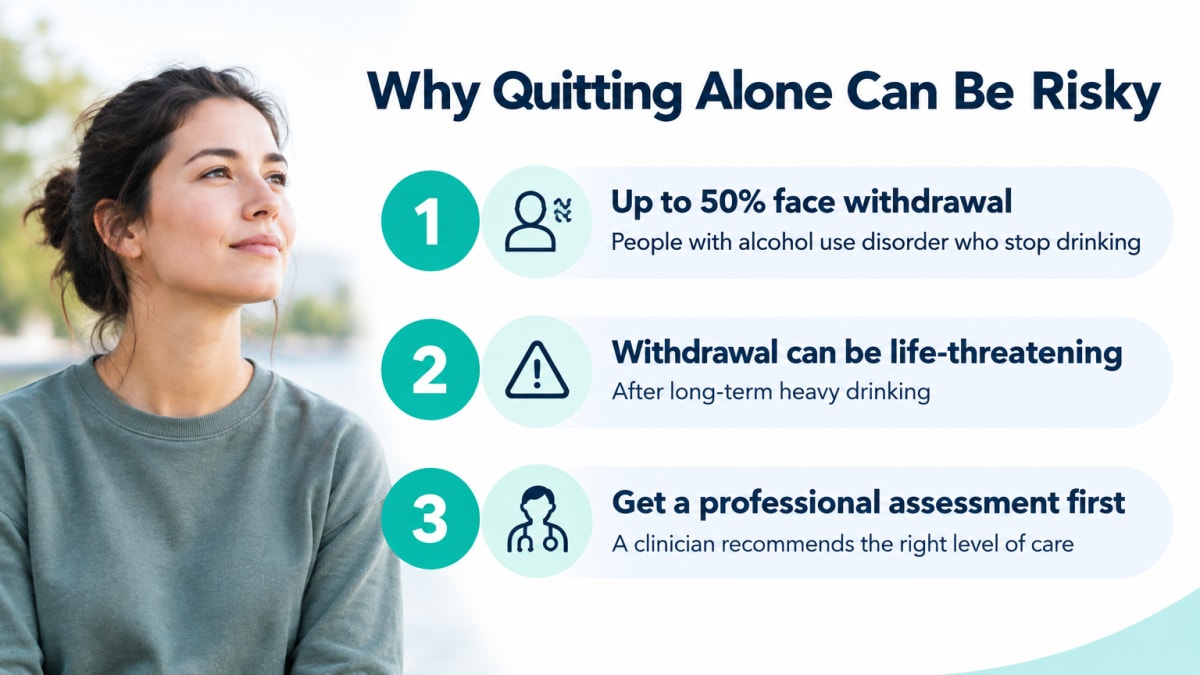
- Steer a loved one away from quitting suddenly alone after daily heavy drinking, since withdrawal can be life threatening. A professional assessment can point to the safest level of care.4
- A refusal does not end your influence. Family-focused approaches like CRAFT have been linked to higher treatment engagement.9
- In Texas, you can explore treatment before your loved one agrees by contacting a program, an OSAR center, or a Local Mental or Behavioral Health Authority.6
Notice It at the Holiday Table, Then Talk About It Later
To help a loved one with addiction during the holidays, watch for patterns rather than one rough night. Keep the gathering safe and low-pressure, and save the serious conversation for a private moment when your loved one is sober. Then set a boundary you can actually keep and line up a concrete next step, such as calling a treatment provider for guidance. You can make that call even if your loved one is not ready yet.
The holidays often bring families together, making problems that were once easy to ignore more apparent. You might notice a sibling frequently leaving to drink in their car, a parent’s promise to reduce drinking not holding, or someone attempting to drive while impaired.
It is natural to want to protect both the holiday spirit and your loved one. You do not have to choose. The dinner table is where you observe; a quiet conversation a day or two later is where you act.
This guide covers each stage: before, during, and after the gathering. It also explains how to find treatment in Texas.
What Signs Should You Watch for at Holiday Gatherings?
One extra glass of wine or a single loud toast does not indicate a problem. A pattern, however, tells you more: something you noticed last year, again at Thanksgiving, and again this week. Holidays condense a lot of family time into a few days, so changes that might be missed over the phone can become evident quickly in person.
The National Institute on Alcohol Abuse and Alcoholism (NIAAA) lists several signs of alcohol use disorder that families can often observe.3 At a holiday gathering, these might include:
- Drinking more or longer than planned. “Just one” turns into starting early or staying late.
- Trying to cut back and not managing to. A previous promise to reduce drinking quietly fell apart.
- A lot of time spent drinking or recovering. They show up hours late or spend the next morning in bed.
- Missed family responsibilities. The dish they promised never arrives, or they miss a child’s event.
- Drinking despite relationship problems. The same arguments recur, and the drinking continues.
- Risky situations. Driving or watching children after drinking.
Alcohol use disorder is a medical condition where a person has difficulty stopping or controlling their drinking, even when it causes problems. Clinicians diagnose it when two or more symptoms occur within a set period, so one holiday incident is not a diagnosis.3 Your role is not to diagnose, but to notice.
With other substances, watch for similar behavioral changes: disappearing for long stretches, broken plans, or new secrecy. Jot down what you observed and when. These specific details will be helpful when it is time to talk.
How Can You Make the Gathering Safer Before Anything Happens?
You cannot control someone else’s drinking, but you can influence the environment. A few changes before guests arrive can ease pressure on everyone, including a loved one who is struggling and anyone choosing not to drink.
NIAAA recommends offering water, juice, sparkling soda, and other alcohol-free choices, not pressuring guests to drink, and supporting a person’s decision not to drink without criticism.2 Here is what that can look like at your table:
- Make alcohol-free drinks inviting. Place them prominently, not hidden.
- Accept a “no thanks” without question. No teasing or insistence on “just one.”
Then, plan your own approach for the day:
- Pick a check-in buddy, such as a sibling or partner, who understands your concerns and can offer support.
- Arrange rides beforehand so no one feels compelled to drive while impaired.
- Center the day’s activities around something other than drinks, such as a walk, a game, or a gift exchange.
These steps do not solve the larger problem, but they create a calmer setting, which is a significant step.
What Should You Do If Your Loved One Is Using at the Gathering?
How Do You Redirect the Moment Away From the Table?
If your loved one’s voice is getting louder and relatives are staring, it is not the time to address their drinking. Someone who is intoxicated is not ready for a serious conversation, and raising the issue in front of others usually turns your concern into their embarrassment.
Instead, change the scene. Try a simple, friendly line:
- “Hey, come help me in the kitchen for a minute.”
- “Want to step outside and get some air with me?”
- “Let’s grab some water and take a break.”
Offer food and an alcohol-free drink. Discreetly move car keys out of sight, and let your check-in buddy manage the rest of the room. Save your observations for later. Getting through the evening calmly is a success.
When Should You Call 911 Instead of Waiting?
The “talk later” rule only applies when everyone is safe. Some situations require immediate action. Call 911 right away if:
- Your loved one is unresponsive, cannot be woken, or appears to have trouble breathing.
- They are about to drive after drinking or using and refuse to hand over the keys.
- A child or anyone else is in danger, or someone is threatening harm.
If it is safe, stay with the person until help arrives. Making that call is not an overreaction or a betrayal; it is protecting them.
How Do You Talk to a Family Member About Their Drinking or Drug Use?
When Is the Right Time to Have the Conversation?
One practical option is to wait a day or two after the gathering. Choose a private place, a time when your loved one is sober, and a period when neither of you is rushed. Morning coffee or a quiet drive may feel more comfortable than a crowded living room.
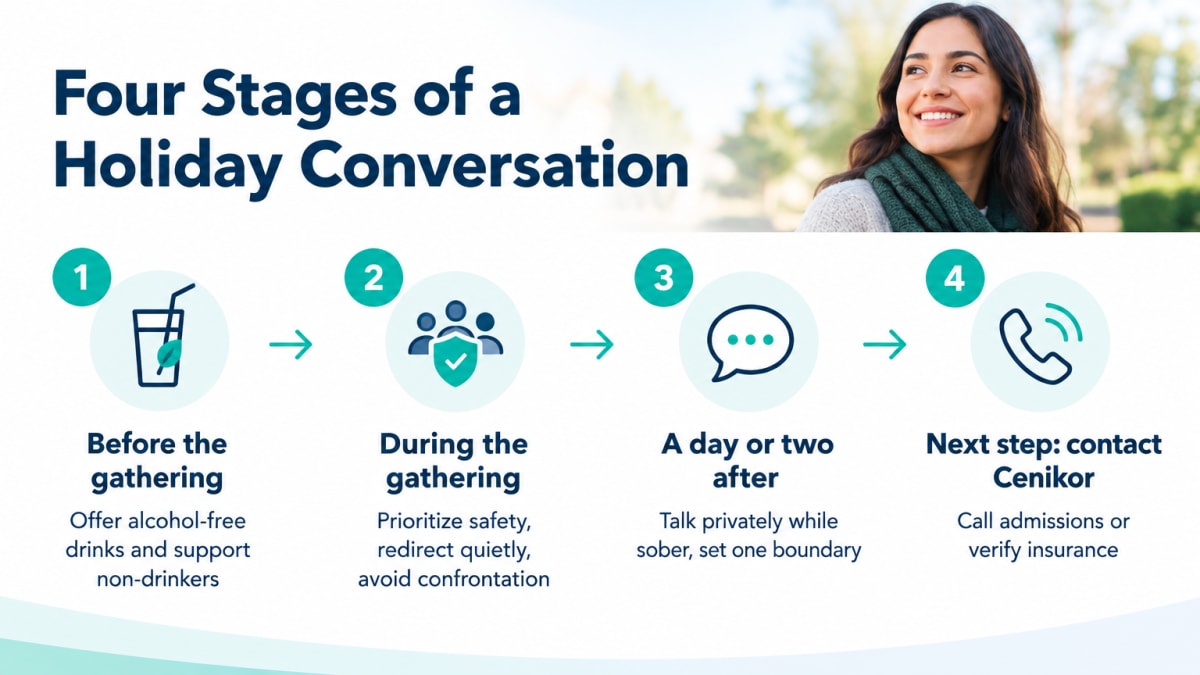
Consider the holiday interaction in four stages:
- Before: Set out appealing alcohol-free drinks like water, juice, and sparkling soda, and support anyone who chooses not to drink.2
- During: Prioritize safety, redirect quietly, and avoid confrontation.
- After: Talk privately while they are sober. Use specific observations and set one boundary.
- Next step: Contact Cenikor’s admissions team or verify insurance at cenikor.org.
What Can You Actually Say? Scripts Built on Specific Observations
Start with what you observed, not your interpretation. Describe specific moments rather than broad conclusions like “you have a problem.”
Use “I” statements that describe a specific moment and how it affected you:
- “At Thanksgiving, I saw you leave twice to drink in the car, and I was scared.”
- “You were supposed to pick up the kids on Christmas Eve and didn’t. I felt like I couldn’t count on you.”
- “When you reached for your keys after the party, I was worried you’d get hurt.”
Then, express your care and offer a pre-arranged next step:
- “I love you, and I miss how things used to be.”
- “I found a place we can call together, just to ask questions.”
After that, stop and listen. Allow for silence. They may become defensive, deny the issue, or change the subject. This is a common initial reaction and does not mean you have failed.
This conversation is challenging, and your voice may shake, which is perfectly acceptable. If the discussion ends with “I’ll think about it,” that is progress. You have opened a door, and you can revisit it.
Which Phrases Tend to Start a Fight?
Certain words can shut down a conversation before it begins. Try to avoid these:
- Labels. “You’re a drunk” can prompt them to defend their identity rather than hear your observations.
- Comparisons. “You’re turning into Dad.”
- Ultimatums made in anger. “Quit or don’t bother coming for Christmas.” A calm boundary is different, and the next section covers it.
- “Why can’t you just stop?” This sounds simple to you, but it rarely feels simple to them.
- Arguing while they are intoxicated. A conversation while someone is intoxicated is unlikely to go well.
If you slip, you can repair it immediately: “That came out wrong. Can I try again?”
What Boundaries Actually Help?
A boundary is a clear statement about what you will do, not a rule about what your loved one must do. You cannot force someone to stop drinking, but you can decide whether you will ride in their car.
Here are a few examples you can adapt:
- Driving: “I won’t ride with you if you’ve been drinking. I’ll get a ride or call a car.”
- Gatherings: “If things get heated, I’m going to leave the party early.”
- Covering: “I’m not going to make excuses for you with Mom anymore.”
- Kids: “The kids won’t stay over on a night when there’s been drinking.”
Choose one or two boundaries, not five. State them calmly during the sober conversation, not in the middle of an argument. Then, follow through when the situation arises.
Boundaries are not punishment or a means to win. They are meant to protect you and those around you, and they can stop shielding your loved one from the consequences of their substance use. This may feel unkind, but it is honest.
Expect resistance. Your loved one may call you dramatic or try to bargain. You can remain supportive while holding firm: “I love you. My answer is still no.” Each time you maintain a boundary without yelling, you show consistent support.
Why Shouldn’t Your Loved One Quit Suddenly on Their Own?
It is New Year’s Day, and your loved one declares they are stopping drinking, starting today. This decision deserves encouragement. However, if they have been drinking heavily every day, stopping abruptly at home without medical supervision can be risky.
Medical detox is supervised care that helps a person safely manage withdrawal. It is only a starting point. NIAAA notes that detox alone is not complete treatment, and continued residential or outpatient care may be needed to support long-term recovery.5
Instead of urging a sudden quit, aim for a professional assessment first. You might say: “I’m proud of you for wanting to stop. Can we call someone together and find out the safest way to do it?” A clinician can assess the duration and intensity of their drinking and recommend an appropriate level of care. You do not have to figure this out alone.
What If Your Loved One Says No?
Can Families Still Help After a Refusal?
Your sister listened, then said, “I don’t have a problem. Drop it.” This is disheartening, but it is a common initial response and does not negate your influence.
Community Reinforcement and Family Training (CRAFT) is a family-focused approach in which family members and other concerned significant others receive trained support. One randomized trial studied concerned significant others whose loved ones had initially refused treatment. Treatment engagement was 58.6% with CRAFT alone, 76.7% with CRAFT plus aftercare, and 29.0% with Al-Anon/Nar-Anon facilitation.9 This is one older study, and the family members worked with trained counselors. Consider it encouraging, not a guarantee.
A German trial showed similar results, following family members of people with alcohol dependence. At three months, treatment engagement was 40.5% in the group that started CRAFT immediately, compared with 13.9% in the group placed on a waitlist. The family members’ own well-being and family cohesion also improved.10 Germany’s health system differs from Texas, so results here may vary.
For everyone else, a “no” today is not a final answer.
Why Getting Support for Yourself Is Part of the Plan
When you are worried about someone, your own needs often fall to the bottom of your priority list. Seeking help for yourself is not a diversion from helping them; it can be one of the most effective actions you take.
In a 2024 secondary analysis of a CRAFT trial, family members who informed their loved one that they were receiving CRAFT help had 2.29 times higher adjusted odds of that loved one engaging in treatment.11 This indicates an association, not direct causation. Still, being open about seeking support demonstrates to your loved one what asking for help can look like.
You could simply say: “I’ve started talking to someone about how to handle all this. It’s helping me.” Leave it at that, without adding pressure.
Continue to seek support for your own well-being. Ask a treatment provider about family support, prioritize your sleep, and lean on a friend who understands. A more stable you is better prepared for future conversations.
Does Addiction Treatment Involve the Family?
Often, yes, and family involvement can be very impactful. SAMHSA reports that involving family may improve how well a person engages in treatment, how long they stay, and their outcomes afterward.1 Positive family support is associated with long-term recovery, while ongoing conflict and pressure to use can increase the risk of relapse.1
Family involvement typically takes a few forms:
- Family education. You learn about substance use disorder, what treatment entails, and how to respond without blame.
- Family counseling. You and your loved one meet with a counselor in structured sessions to rebuild communication and trust.
“Family” is a broad term. SAMHSA includes relatives, friends, partners, and family of choice when the person in treatment names them.1 Your loved one decides who participates. Ask what they want instead of assuming, and respect their answer.
Research on family involvement is encouraging and continues to grow. A 2026 systematic review examined randomized trials published from 2012 through 2024. Of the 15 trials included, 11 reported significant positive effects of family-based interventions. The authors also noted the need for more high-quality studies.8
How Do You Get a Loved One Into Treatment in Texas?
Texas offers multiple pathways to treatment, and you can begin exploring options even before your loved one agrees to go. Texas Health and Human Services lists three main routes for adults: contacting a treatment program directly, reaching a local OSAR center, or calling a Local Mental or Behavioral Health Authority.6 An OSAR (Outreach, Screening, Assessment, and Referral) center is an access point for adult substance use services.
Here is a simple order to follow:
- Gather the basics. Note what you have observed, how long it has been occurring, and any past treatment. If possible, include their insurance card details.
- Check Medicaid coverage, if applicable. Texas Medicaid substance use benefits can include assessment, individual and group counseling, residential treatment, withdrawal management, and medication-assisted treatment.7 Your loved one’s specific plan still determines benefits, authorization rules, and available providers.7
- Ask about in-network benefits. In-network means the treatment provider has a contract with the insurance company. Commercial plans through an employer vary in deductibles, out-of-pocket costs, and covered services. Have a provider verify the plan before making assumptions.
- Contact Cenikor. Call Cenikor’s admissions team or verify insurance at cenikor.org. You can ask questions on your loved one’s behalf. After an assessment, admissions can recommend a level of care.
You do not need every answer before reaching out. Learning the options now is a crucial step, ensuring a plan is ready the moment your loved one says yes.
How Does Cenikor Help Families During the Holidays and Beyond?
Cenikor is a nonprofit that provides substance use treatment in Texas and New Mexico. You do not have to wait for your loved one to agree. Family members can call on a loved one’s behalf to ask questions and learn about their options.
Cenikor’s mission, behavioral health for all, includes chosen family. A partner, roommate, or close friend is welcome to reach out. Every call is handled with no shame and no judgment, whether you are calling for someone else or for yourself.
After an assessment, admissions can recommend a level of care. Services vary by location, so ask admissions which options are available near you. Depending on location, options may include:
- Medical detox for safe, supervised withdrawal care.
- Residential treatment with professional staff on site to meet each client’s needs.
- Outpatient treatment for people who need care while maintaining work and family responsibilities.
- Medication-assisted treatment with buprenorphine for opioid use disorder.
- Aftercare and recovery support services, which may be available at no cost depending on eligibility and funding type.
Family support services help you stay involved in a way your loved one agrees to.
Your next step is simple: call Cenikor’s admissions team or verify insurance at cenikor.org.
Frequently Asked Questions
Here are short answers to the questions families ask most often during the holidays.
What are the signs a loved one is struggling during the holidays?
Look for patterns of behavior rather than isolated incidents. Signs of alcohol use disorder, as described by NIAAA, include drinking more or longer than planned, trying unsuccessfully to cut back, spending a lot of time drinking or recovering, missing family responsibilities, drinking despite relationship problems, or engaging in risky situations like driving after drinking.3 For other substances, watch for similar changes in behavior, such as disappearing for long periods, broken plans, or increased secrecy. Document specific observations to help with future conversations.
How do I bring up treatment without starting a fight?
Choose a private moment when your loved one is sober, such as a day or two after the gathering. Use “I” statements to describe specific observations rather than making broad accusations. For example, “I saw you leave twice to drink in the car, and I was scared,” instead of “You have a problem.” Express your care and offer a concrete next step, such as calling a treatment center together to ask questions. Avoid labels, comparisons, angry ultimatums, or arguing while they are intoxicated.
Can I call Cenikor on behalf of someone else?
Yes. You do not need your loved one’s permission to ask questions and learn your options. In Texas, you can contact a treatment program directly, a local OSAR center, or a Local Mental or Behavioral Health Authority.6 Family members are welcome to call Cenikor’s admissions team on a loved one’s behalf. You can ask how admissions works and what insurance may cover. That way, a plan is ready when your loved one says yes.
What if my loved one says no?
A refusal is a common initial response and does not end your influence. Family-focused approaches like Community Reinforcement and Family Training (CRAFT) have been linked to higher treatment engagement.9 Additionally, seeking support for yourself can be beneficial. In a 2024 analysis, family members who told their loved one they were receiving CRAFT help had higher odds of that loved one engaging in treatment.11 Continue to offer support and maintain boundaries, understanding that a “no” today is not necessarily a final answer.
References
- THE IMPORTANCE OF FAMILY THERAPY Advisory 39. https://library.samhsa.gov/sites/default/files/pep20-02-02-016.pdf
- The Truth About Holiday Spirits. https://www.niaaa.nih.gov/publications/brochures-and-fact-sheets/truth-about-holiday-spirits
- Understanding Alcohol Use Disorder. https://www.niaaa.nih.gov/publications/brochures-and-fact-sheets/understanding-alcohol-use-disorder
- Alcohol Use Disorder: From Risk to Diagnosis to Recovery. https://www.niaaa.nih.gov/health-professionals-communities/core-resource-on-alcohol/alcohol-use-disorder-risk-diagnosis-recovery
- Recommend Evidence-Based Treatment: Know the Options. https://www.niaaa.nih.gov/health-professionals-communities/core-resource-on-alcohol/recommend-evidence-based-treatment-know-options
- Adult Substance Use Services. https://www.hhs.texas.gov/services/mental-health-substance-use/adult-substance-use-services
- Texas Medicaid and CHIP Reference Guide – 15th Edition. https://www.hhs.texas.gov/sites/default/files/documents/texas-medicaid-chip-reference-guide-15th-edition.pdf
- Efficacy of Family-based Interventions in Addressing Substance Use Disorders: A Systematic Review on Randomized Controlled Trials. https://pubmed.ncbi.nlm.nih.gov/41970367/
- A randomized trial of two methods for engaging treatment …. https://pubmed.ncbi.nlm.nih.gov/12362968/
- Efficacy of the Community Reinforcement and Family Training (CRAFT) in Germany: A randomized controlled trial. https://pubmed.ncbi.nlm.nih.gov/27141840/
- Potential factors affecting the impact of community reinforcement and family training. Secondary analysis of an RCT. https://pubmed.ncbi.nlm.nih.gov/38233850/
Recovery Built for Real Life
Recovery doesn't have to feel out of reach. At Cenikor, we provide practical, affordable care designed for real life—whether you're navigating substance use, supporting a loved one, or helping someone find the right level of care.
Explore Your Options Written by Cenikor’s Clinical & Compliance Team