

Recovery That Meets You Where You Are
Whether you're reaching out for yourself, someone you care about, or a client in need of support, Cenikor is here to help you take the next step. With flexible, evidence-based care and a commitment to serving everyone, we make recovery more accessible—and more sustainable.
Start the ConversationKey Takeaways
- Replace rigid summer schedules with five daily anchor points—wake window, movement, real social time, screens-off window, and sleep window—so structure protects mood without feeling like a boot camp14
- Hold a consistent sleep window of 8 to 10 hours and charge phones outside the bedroom, since parent-set bedtimes are linked to teens actually sleeping more3
- Build 45 to 60 minutes of daily movement into the day, ideally with another person attached, because summer pulls teens toward sedentary screen time that worsens mood and sleep9
- Engineer two face-to-face social touchpoints a week through camps, jobs, or friends on the couch, since structured in-person settings outperform group chats for teen well-being8,13
- Protect a phone-free first hour, one screen-free meal, and an overnight charging spot outside the bedroom instead of policing minutes, since heavier screen use tracks with mood symptoms and substance risk10,15
- Stay in the loop transparently by knowing where your teen is, who they’re with, and what they’re doing online—informed monitoring lowers risk without damaging trust1,11
- Have ten-minute side-by-side conversations several times a week, leading with curiosity and reacting to feelings before facts, to keep honest dialogue open all summer4,6
- Treat patterns lasting weeks—persistent sadness, withdrawal, sharp irritability, or substance signs—as the threshold to call a professional rather than wait it out2,6,7
Why summer hits different for teens
You can feel the shift the first week school lets out. The morning alarms go quiet, dinner times slide later, and your teen’s social life moves into a phone in a dark bedroom. None of that is a crisis on its own. But put it all together, for ten or twelve weeks, and summer can quietly chip away at the things that keep teens emotionally steady.
The school year does a lot of invisible work. It sets wake times, fills the day with face-to-face contact, requires movement between classes, and gives most teens a built-in reason to be tired by 10 p.m. When that scaffolding disappears, sleep drifts, days get more sedentary, and screen time climbs — a pattern researchers have flagged consistently in summer break studies. Heavier screen use, in turn, has been linked with more mood symptoms and higher substance-use risk in adolescents.9,10,15
Here’s the good news, and it’s real: the same loss of structure that makes summer harder also makes your influence bigger. You’re around more. You see the moods. You notice when the friend group changes. A handful of small, consistent habits at home — sleep, movement, real conversation, knowing where they are — protect teens in ways that are well documented. The rest of this guide walks you through what to actually do, week by week, without turning your house into a boot camp.1,14
Build a summer rhythm, not a strict schedule
Forget the color-coded summer chart taped to the fridge. Your teen will roll their eyes at it by day three, and you’ll feel like a failure by day five. What actually protects mood and behavior over a long break is a rhythm — a small number of anchor points your family hits most days, with plenty of soft space in between.
Think of it as five fixed posts, not sixty-five filled-in hours:
- A wake window most mornings.
- A movement block sometime before dinner.
- Real social or outdoor time.
- A screen-off window in the evening.
- A sleep window long enough to actually rest — 8 to 10 hours per night for ages 13 to 18, per CDC guidance.3
Between those posts, your teen can sleep in a little, hang out, get bored, take a long shower, scroll, read, whatever. The anchors do the protective work; the in-between is theirs.
This loose-but-real approach matters because summer specifically pushes kids toward more sedentary time and screen use, and a steady routine plus a flexible day is what pediatric behavioral guidance actually recommends — regular sleep and meal times, planned activities, and a “cope ahead” chat about what’s coming this week. You’re not micromanaging. You’re keeping the day from collapsing into noon-wake, midnight-bedtime drift.9,14
One practical move: sit down on Sunday for ten minutes and sketch the week together. What’s happening Wednesday afternoon? Are they seeing friends Friday? When’s the family dinner? Let your teen weigh in on the in-between. They’re far more likely to honor a rhythm they helped shape, and you both get a quiet sense of what the week looks like before Monday lands.

Protect sleep like it’s a household policy
If you only enforce one thing this summer, make it sleep. Teens ages 13 to 18 need 8 to 10 hours a night, and parent-set bedtimes are actually associated with teens getting more sleep — not less, even when they push back. That second part matters. You’re not being controlling. You’re being the reason the math works.3
Summer wrecks sleep in a few predictable ways. Bedtime drifts later because there’s no 7 a.m. alarm pulling against it. Phones come to bed. Late-night gaming or scrolling lights up the brain right when it should be winding down. By the third week of June, your teen is sleeping from 2 a.m. to 11 a.m. and waking up grumpy, foggy, and snappish — and you’re wondering if something deeper is wrong. Often, it’s just sleep debt wearing a costume.
Pick a sleep window your household can actually hold most nights. Something like “asleep by midnight, up by 10” is realistic for a lot of teens in summer and still lands inside the 8-to-10 hour zone. Then build two small rituals around it: a charging spot for phones outside the bedroom, and a screens-off cue about 30 to 45 minutes before lights out. You don’t have to pry the phone away — you have to make the kitchen counter the place it sleeps.3
Expect pushback the first week. Hold the line anyway. When sleep stabilizes, mood usually follows within a few days, and the rest of your summer plan gets easier to run.
Move the body, then the mood follows
You don’t need your teen to become an athlete this summer. You just need them off the couch for a chunk of most days. Movement is one of the cheapest, fastest mood regulators you have, and summer break tends to pull teens in the opposite direction — researchers consistently find more sedentary behavior and screen time during the break than during the school year. The body that sat still all day is usually the body that can’t sleep at 11 p.m. and feels heavy and irritable by morning.9
Aim for something like 45 to 60 minutes of real movement a day, broken up however it fits. A morning walk with the dog. Pickup basketball at the park. Swimming. Yard work that actually counts. A bike ride to a friend’s house instead of a ride from you. The activity itself matters less than the fact that it happens, outside if possible, and not alone in a bedroom.
Two small things tend to work better than lectures. First, put the movement on the calendar with someone else attached — a friend, a sibling, you. Teens show up for plans involving other people far more reliably than for plans involving willpower. Second, make the easy choice the active one. Park the car farther. Keep the basketball by the door. Walk to get the iced coffee instead of driving. You’re not engineering a workout plan; you’re keeping the day from going completely flat.
Real-world connection beats group chats
Group chats are not the enemy, but they’re also not the same thing as being with someone. A teen can text 200 messages a day and still feel completely alone by Thursday. Summer pulls more of their social life onto screens by default — the school hallway disappears, practice ends, and suddenly the easiest “hangout” is a Snapchat thread at 1 a.m. That shift matters because heavier screen use in adolescents has been linked to more mood symptoms and higher substance-use risk.10,15
What seems to protect teens is the boring, in-person stuff. A friend on the couch. A car ride to get tacos. A pickup game where nobody’s filming. Structured summer settings — camps, jobs, volunteer roles, sports clinics, youth groups — show measurable benefits for mental health, social-emotional well-being, and behavior, partly because they put kids in rooms with other kids who are present, not pixelated. You don’t need to enroll your teen in something every week. One or two anchors of real-world contact tend to do real work.8,13
Try to help engineer two face-to-face touchpoints a week that don’t require you to drive them somewhere alone with their thoughts. A friend over for dinner. A summer shift at a coffee shop or pool. A church youth night. A free city rec league. If your teen says no to everything, lower the bar — invite one friend over to watch a movie at your house. The goal isn’t a packed calendar. It’s making sure the group chat isn’t the only place they exist this summer.
Set screen boundaries without starting a war
Screens are the single hardest fight of summer, and pretending otherwise won’t help you. Your teen’s friends are in the phone. Their music is in the phone. Their boredom relief is in the phone. So the goal isn’t zero screens — it’s keeping screens from eating the entire day and the entire night. The research is consistent enough to take seriously: heavier adolescent screen use is associated with more mood symptoms and with higher likelihood of substance use, especially when depression or anxiety risk is already in the mix.10,15
Instead of trying to police minutes, pick two or three windows you actually protect:
- A phone-free first hour of the day, so mornings don’t start in a doomscroll.
- A phone-free family meal, even if it’s just one a day.
- And a hard screens-off window before bed — phones charge in the kitchen, not on the nightstand.
That last one alone tends to do more for mood and sleep than any app limit you can set.
Frame the rule, then frame the why. “Phones sleep in the kitchen” is a household norm, not a punishment. “We eat dinner without screens because I want to hear about your day” is connection, not control. Expect grumbling. Hold the boundary anyway. If your teen pushes back hard, that’s worth a calm conversation, not a bigger fight — ask what they’re worried about missing, and listen before you respond.
One more thing: model it. If your phone is on the dinner table or in your hand at 11 p.m., your teen sees the real rule. The boundary works best when it applies to the whole house, including you.
Stay close without hovering: monitoring as connection
Monitoring has a bad reputation, and most of that is a vocabulary problem. You’re not running surveillance. You’re staying in the loop. The CDC frames parental monitoring as knowing where your teen is, who they’re with, and what they’re doing — including online — and ties that informed presence to fewer risky behaviors and better mental health. The mechanism isn’t fear. Researchers studying how monitoring actually works find it reduces opportunity and shifts what teens expect to happen in a given moment — they’re simply less likely to wander into a risky situation when they know a parent is paying attention.1,11
The framing matters. “Where are you going, who’s driving, when will you be back, text me when you get there” is connection. It’s also a habit your teen can carry into adulthood. A short check-in when they walk in the door — eye contact, two real questions, no interrogation — does more than any tracking app. Know the friends. Know the parents whose houses they’re going to. Know what platforms they’re spending time on, even if you don’t read every message. That’s presence, not policing.
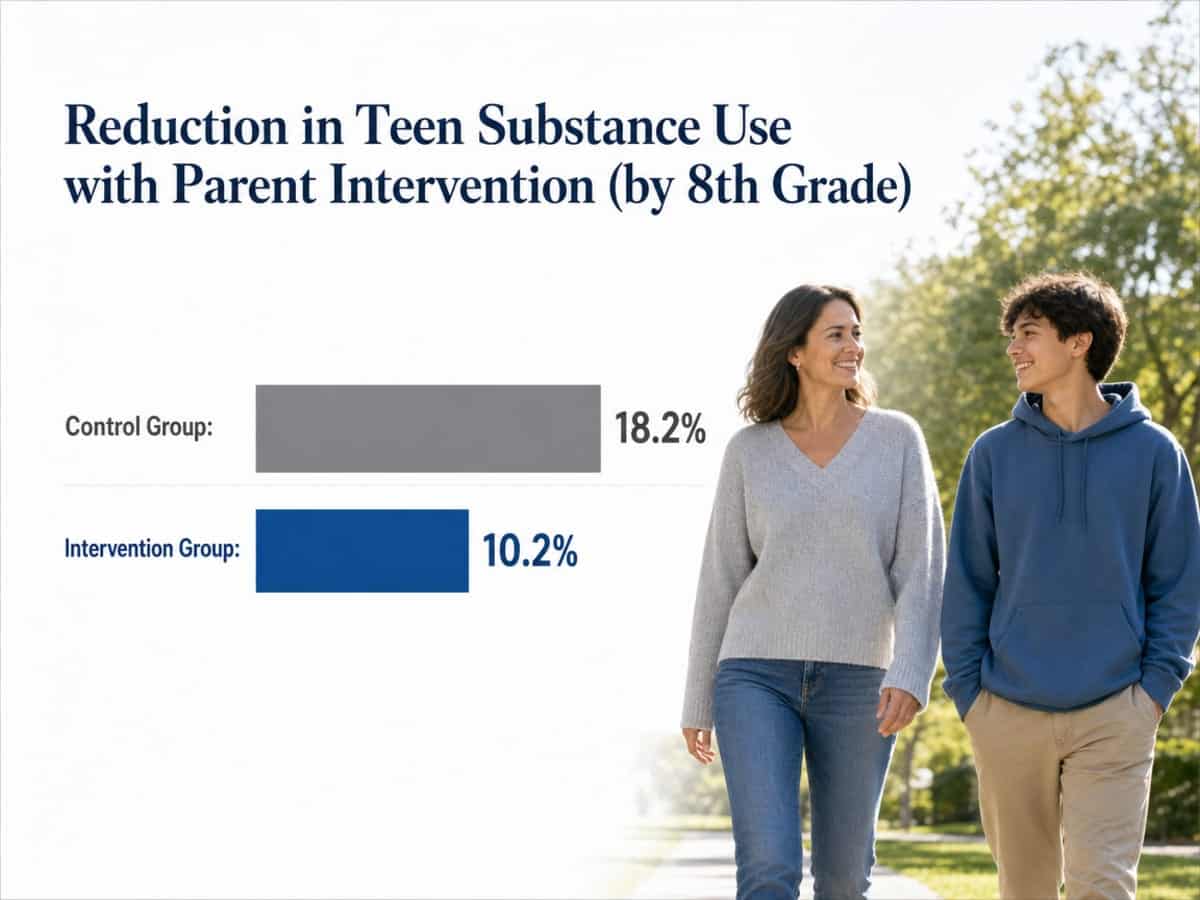
And your involvement actually moves numbers. In a parent-facing prevention trial, lifetime alcohol or marijuana use by eighth grade dropped from 18.2% in the control group to 10.2% in the group whose parents received the intervention — roughly a 44% relative reduction. That’s a study of middle schoolers whose families learned simple communication and monitoring practices, not a guarantee for any individual teen, but it tells you the direction of the effect is real. The boring, repeated stuff — knowing the plan, asking the questions, holding the small rules — adds up.12
One caution: monitoring works best when it’s transparent. Secretly reading the entire phone tends to blow up trust the first time it’s discovered. Telling your teen up front what you check, why, and what would change as they get older keeps the relationship intact while the protection stays in place.
Have the 10-minute conversation that actually lands
You don’t need an hour. You need ten minutes, done often, where your teen does most of the talking. The CDC’s guidance to parents is steady on this: honest, judgment-free conversations are what build the kind of trust that protects teens from substance use and emotional drift — and the trick is doing it before there’s anything to be worried about.4
Pick a moving setting. Side by side beats face to face for most teens. A car ride to pick up dinner. Folding laundry together. Walking the dog after it cools off. Eye contact every two seconds feels like an interview; a shared task lowers the temperature and gives them somewhere to look while they figure out what they actually want to say.
Open with curiosity, not a checklist. “What’s something that’s been weird this week?” lands better than “How are you?” If they say “nothing,” try once more with something specific — a friend you noticed they haven’t mentioned in a while, a show they’re watching, the group chat that’s been blowing up their phone. Then stop. Silence is not failure. Most teens need a few seconds to decide you actually want the real answer.
When they do talk, your job is mostly to not flinch. SAMHSA’s parent guidance is direct about this: lead with compassion, keep it judgment-free, and react to feelings before facts. If your teen tells you something that scares you a little — a friend who’s drinking, a low day, a fight you didn’t know about — say “thanks for telling me” first. The lecture can wait until tomorrow. The opening you just got might not come back if you spend it correcting them.6
Aim for one of these short conversations a few times a week, not a single big sit-down on Sunday. Ten honest minutes, repeated, is how you stay in the loop all summer.
Normal summer slump vs. worth a closer look
Teens get weird in the summer. They sleep until noon, snap at you over nothing, vanish into their rooms for six hours, and suddenly hate the food they loved in May. Most of that is just summer. The hard part is knowing when it’s not.
The line isn’t about any single behavior. It’s about how long it lasts and whether it’s getting in the way of your teen’s life. NIMH is clear on the threshold: if a behavior change lasts weeks or longer, causes real distress, or interferes with how your teen functions at home, at school, or with friends, that’s the point where you stop watching and start asking for help. SAMHSA names the specific signs worth taking seriously — persistent sadness, withdrawal from people they used to enjoy, sharper irritability, drug or alcohol use, and drastic shifts in how they act day to day.6
Here’s a side-by-side that may help you sort what you’re seeing:
Normal summer slump:
- Sleep: Bedtime drifts later, wakes up at 11 a.m., but still sleeps a solid 8–10 hours and seems rested 3.
- Mood: Cranky in the morning, fine by lunch. Bored on a Tuesday, laughing with a friend by Wednesday.
- Friends: Quieter social calendar than the school year, but still texting, still saying yes to some plans.
- Energy: Lazy stretches mixed with normal interest in food, music, shows, the pool, the dog.
- Substances: No signs you can see.
Worth a closer look:
- Sleep: Up most of the night, sleeping all day, or barely sleeping at all — and it’s been like this for three or four weeks.2
- Mood: Persistent sadness, hopelessness, or anger most days. Crying that doesn’t pass. Talk that scares you.6
- Friends: Dropped the old crew with no explanation, or pulled away from everyone. Withdrawal that lasts.6
- Energy: Lost interest in things they used to love. Not eating, or eating in ways that feel off. Grades or summer-job performance slipping.2
- Substances: You smell it, you find it, you notice money missing, or their behavior changes drastically and you can’t explain why.6
One bad week isn’t the signal. A pattern is. If you’re reading the right-hand column and nodding for more than two or three weeks, trust that. You don’t need to be sure something is wrong to make a call — you just need to be unsure enough that a professional opinion would help. The next section walks you through what that looks like.

When home effort isn’t moving the needle
You’ve held the sleep window. You’ve kept dinner phone-free. You’ve asked the questions, made the rides, invited the friends over. And three or four weeks in, something still feels off. The mood hasn’t lifted. The withdrawal hasn’t softened. You’re not imagining it.
That’s the moment to bring in help, and it’s not a failure of your parenting. NIMH is direct about the line: when changes last weeks or longer and interfere with home, school, or friendships, it’s time to contact a professional. SAMHSA points families to three doors that are open right now — call or text 988 for a crisis or scary thoughts, call SAMHSA’s National Helpline at 1-800-662-HELP for treatment guidance, and search FindTreatment.gov for nearby options. None of those require a diagnosis to use. They’re for the in-between moment you may be in.2,5,7
Cenikor is one of those nearby options for families in Texas and New Mexico. As a nonprofit with nearly six decades of experience, Cenikor offers a full continuum of care for teens — from outpatient support to residential treatment, with services for substance use and, at most locations, wellness and recovery support that addresses what’s underneath the behavior. We work with over 30 major insurance carriers so cost is less likely to be the wall that stops you from making the call. If what you’ve tried at home hasn’t moved the needle, reach out. An honest conversation with someone trained to listen is a first step, not a commitment.
One thing to do this week
Don’t try to install every habit in this guide by Friday. Pick one. The parent who runs the sleep window for two weeks straight will get a steadier teen than the parent who tries all five anchors at once and burns out by Wednesday.
If you’re not sure where to start, pick the phone charger. Move it to the kitchen counter tonight. Tell your teen, calmly, that’s where phones sleep now — including yours. That single change tends to pull bedtime earlier, mornings less foggy, and dinner a little more present, all without a fight about screen time minutes.3,10
One small win this week. Then another next week. That’s how summer stays steady — and how you stay close enough to notice if something bigger is starting to surface.
Your path to healing begins with a single call—reach out today to discover how our experienced team can help you reclaim your life and build the future you deserve.
Frequently Asked Questions
How much sleep does my teen actually need during summer break?
Teens ages 13 to 18 need 8 to 10 hours of sleep per day, even when school is out. Summer makes this harder because the alarm goes quiet and bedtime drifts later. Parent-set bedtimes are actually linked to teens getting more sleep, not less, so holding a realistic window matters.3
How do I tell the difference between a normal summer slump and something more serious?
Length and impact are the line. A few cranky weeks or a quieter social calendar is usually just summer. If changes in sleep, mood, friendships, or interest last weeks or longer and start interfering with home, friendships, or summer responsibilities, that’s the threshold to bring in a professional. Persistent sadness, withdrawal, sharp irritability, or any substance signs deserve a closer look.2,6,7
How much screen time is too much for a teenager in the summer?
There’s no magic number, but the patterns matter. Heavier screen use in teens is linked to more mood symptoms and higher substance-use risk, especially when anxiety or depression is already present. Instead of policing minutes, protect three windows: a phone-free first hour of the day, one screen-free family meal, and phones charging outside the bedroom overnight.10,15
Is checking on my teen’s whereabouts and online activity considered spying?
Not when it’s transparent. The CDC describes parental monitoring as knowing where your teen is, who they’re with, and what they’re doing online — and ties that informed presence to less substance use and better mental health. Tell your teen up front what you check and why. Secret phone searches damage trust; open expectations and regular check-ins keep the relationship intact.1,11
What should I do if my teen refuses to talk to me?
Lower the bar and change the setting. Side-by-side conversations — a car ride, walking the dog, folding laundry — feel less like an interview. Lead with curiosity, not a checklist, and react to feelings before facts so they keep coming back. If silence stretches into weeks alongside withdrawal or mood changes, that pattern itself is information worth a call to a professional.2,4,6
When should I call a professional instead of waiting it out?
Call when changes last weeks or longer and get in the way of daily life at home, with friends, or with summer responsibilities. You don’t need a diagnosis to reach out. Text or call 988 for crisis or scary thoughts, call SAMHSA’s National Helpline at 1-800-662-HELP for guidance, or search FindTreatment.gov for nearby care. Cenikor is one of those options across Texas and New Mexico.2,5,7
References
- Parental Monitoring | Healthy Youth Parent Resources. https://www.cdc.gov/healthy-youth-parent-resources/positive-parental-practices/parental-monitoring.html
- Children and Mental Health: Is This Just a Stage?. https://www.nimh.nih.gov/health/publications/children-and-mental-health
- Sleep and Health | Physical Education and Physical Activity – CDC. https://www.cdc.gov/physical-activity-education/staying-healthy/sleep.html
- Resources for Parents: Teen Mental Health & Drug Use. https://www.cdc.gov/free-mind/parents/index.html
- Mental Health Coping Resources for Parents and Caregivers. https://www.samhsa.gov/mental-health/children-and-families/coping-resources/caregiver
- For Parents and Caregivers of Children – Mental Health – SAMHSA. https://www.samhsa.gov/mental-health/what-is-mental-health/how-to-talk/parents-and-caregivers
- Child and Adolescent Mental Health. https://www.nimh.nih.gov/health/topics/child-and-adolescent-mental-health
- Health effects of children’s summer holiday programs – PMC. https://pmc.ncbi.nlm.nih.gov/articles/PMC11488216/
- Children’s Health, Wellbeing and Academic Outcomes over the Summer Break – PMC. https://pmc.ncbi.nlm.nih.gov/articles/PMC10969660/
- The associations between screen time and mental health in adolescents – PMC. https://pmc.ncbi.nlm.nih.gov/articles/PMC10117262/
- How Does Parental Monitoring Reduce Adolescent Substance Use? – PMC. https://pmc.ncbi.nlm.nih.gov/articles/PMC11095493/
- Engaging Parents to Prevent Adolescent Substance Use – PMC. https://pmc.ncbi.nlm.nih.gov/articles/PMC6727292/
- Effect of Summer Holiday Programs on Children’s Mental Health and Wellbeing: A Systematic Review. https://pmc.ncbi.nlm.nih.gov/articles/PMC11352663/
- How Summer Break Can Affect Your Child’s Mental Health. https://healthcare.utah.edu/healthfeed/2026/05/how-summer-break-can-affect-your-childs-mental-health
- Effects of Depression, Anxiety and Screen Use on Adolescent Substance Use and Abuse. https://pmc.ncbi.nlm.nih.gov/articles/PMC8055606/
Recovery Built for Real Life
Recovery doesn't have to feel out of reach. At Cenikor, we provide practical, affordable care designed for real life—whether you're navigating substance use, supporting a loved one, or helping someone find the right level of care.
Explore Your Options Written by Cenikor’s Clinical & Compliance Team