

Recovery That Meets You Where You Are
Whether you're reaching out for yourself, someone you care about, or a client in need of support, Cenikor is here to help you take the next step. With flexible, evidence-based care and a commitment to serving everyone, we make recovery more accessible—and more sustainable.
Start the ConversationKey Takeaways
- Summer isn’t universally harder on teens, but losing school’s hidden scaffolding—routine, peer contact, and adult check-ins—leaves some adolescents drifting without the daily support that quietly held them steady.2,3
- Watch for clusters, not single signs: persistent sadness, sleep and appetite shifts, withdrawal from friends, and loss of interest lasting more than two weeks signal something beyond typical moodiness.9
- Rebuild a few light anchors rather than recreating school—consistent sleep and meals, 60 minutes of daily movement, one social touchpoint, and shared family time protect emotional wellness.1,4
- When home strategies stall, substance use enters the picture, or your teen mentions hopelessness, a professional assessment is the next step—emotional struggles and substance use in adolescents need to be treated together.8,9,10
Why Summer Hits Some Teens Harder Than Others
You’ve probably noticed it by now. The bedroom door stays closed a little longer. The shrug at dinner lasts a few more days than it used to. And you’re standing in the kitchen wondering whether this is just thirteen, or fifteen, or seventeen — or whether something else is happening underneath.
Here’s what the research actually says, and it’s more honest than the headlines: summer is not automatically harder on every teen. A 2025 study tracking adolescents across the school year and vacation found that depression and anxiety symptoms decreased for many teens once the school pressure lifted. For some kids, June is genuine relief.3
For others, it’s the opposite. When school ends, so does the quiet scaffolding that was holding things together — the morning routine, the daily check-ins from a teacher who noticed, the friend group that sat at the same lunch table. Summer can be a time of both real growth and real risk, and the difference often comes down to access to structure, supportive adults, and meaningful activity.7
So the question isn’t whether summer is bad for teens. The question is whether your teen is one of the ones who needs the scaffolding rebuilt — and how to read the signals early enough to do something about it.
The Scaffolding That Disappears in June
What School Was Quietly Doing for Your Teen
Think about a regular Tuesday in March. Your teen wakes up at roughly the same time. Eats something, even if it’s just a granola bar in the car. Sits near the same handful of kids in second period. Gets asked, in some small way, by at least three or four adults how they’re doing — even if the answer is a grunt.
None of that feels like mental health support. But it is.
School quietly delivers a daily dose of structure, social contact, and adult observation that’s hard to replicate at home. The CDC points to exactly these levers — open communication, supervision, shared activity, and routine adult check-ins — as the everyday practices that protect adolescent well-being. When school is in session, your teen gets a lot of that automatically. You don’t have to manufacture it.2
Then June arrives and the whole apparatus turns off at once. Wake times drift. The lunch table scatters across the city. The teacher who would have flagged the second week of a quiet stretch is on her own break. For a teen who was coasting along just fine on that hidden support, the loss isn’t dramatic. It’s gradual. And that’s part of why it’s easy to miss.
When Extended Time Away Becomes a Risk Factor
Here’s where the research gets uncomfortable, and worth sitting with.
A 2026 longitudinal study tracking children and adolescents over time found that students with school absence above the second quartile had roughly doubled odds of later mental health problems. Persistent absence — defined as missing more than 10% of the school year — was associated with odds ratios near 2.0 across multiple ages. The authors argue this isn’t just a correlation. Extended time away from school appears to be a risk factor in its own right, not only a symptom of difficulties that were already there.5
Now, an important caveat: that study looked at school-year absence, not summer break specifically. Summer is expected time off, with different social meaning than skipping class in October. So don’t read this as “summer doubles your teen’s risk.” That’s not what the data says.
What it does say is that long stretches of low structure, reduced adult contact, and disengagement from the routines that usually anchor a young person’s day are meaningful. Summer is the longest such stretch most teens experience. For a teen who’s already struggling — with friendships, with mood, with the family situation, with anything that was quietly building under the surface in May — those ten or twelve weeks can become the period where things drift further rather than settle.
The takeaway isn’t panic. It’s attention. The same teen who needed light scaffolding in school usually still needs some version of it in July.

Normal Teen Moodiness vs. Signals That Need a Closer Look
What Typical Summer Behavior Actually Looks Like
Before you start cataloging every shift you’ve noticed, let’s name what’s actually normal for a teen between June and August.
Sleeping until eleven. Wanting to be alone in their room with the door closed for stretches at a time. Eye-rolling at family plans they would have happily joined two years ago. Living on their phone with one specific friend group while ignoring the rest of the world. Being bored. Saying they’re bored. Being bored again forty minutes later.
All of that is the texture of adolescence on a Tuesday in July. Teens are wired to pull away from parents and toward peers, and a low-structure summer gives them more room to do exactly that. You may also see them try on new interests, new music, new ways of dressing — sometimes for a week, sometimes for the whole season. That’s developmental, not a warning sign.
What separates typical summer behavior from something worth a closer look is whether your teen still comes back. They retreat to their room, but they emerge for the dog, for pizza, for a show you watch together. They sleep in, but they have moments of genuine engagement. They’re moody, but the mood passes. The lights are still on inside.
Warning Signs for Depression, Anxiety, and Withdrawal
Now for the harder list. The one you may have been quietly comparing your teen against for a few weeks already.
The National Institute of Mental Health is clear that everyone feels sad or irritable sometimes — what separates depression from a rough patch is that the feelings don’t go away and start interfering with daily life at home, school, or with friends. The specific signals parents are asked to watch for include:9
- Persistent sadness or irritability lasting more than two weeks
- Loss of interest in activities your teen used to enjoy — the sport, the friend group, the video game they couldn’t stop talking about in May
- Sleep changes that go beyond summer drift: sleeping fourteen hours and still exhausted, or unable to sleep at all
- Appetite changes — eating noticeably more or less, weight shifts
- Trouble concentrating, finishing anything, or making small decisions
- Withdrawal from friends entirely, not just from family
- Statements about being a burden, hopelessness, or any mention of death, dying, or not wanting to be here
That last one is not a phase. If your teen says any version of it, even casually, treat it as the signal it is and get a professional involved that day. NIMH and SAMHSA both emphasize that families should seek help promptly when these patterns appear rather than waiting to see if they pass 9, 10.
The pattern that should get your attention isn’t any single item on the list. It’s the cluster. A teen who’s sleeping oddly and withdrawing from their closest friends and losing interest in everything they used to love and snapping at small things for three weeks straight is telling you something. You don’t need to diagnose it. You just need to notice it and act.
And here’s the part nobody says out loud enough: you know your kid. If something feels different in a way you can’t quite name, that instinct counts as data. Trust it.

When Substance Use Enters the Picture
Summer is also when alcohol and drugs become more accessible to teens. Older friends with cars. Empty houses in the afternoon. Parties you weren’t told about. Long unsupervised stretches where boredom and curiosity meet opportunity.
SAMHSA points to a set of changes that often signal early substance use: a new friend group your teen won’t introduce you to, sudden secrecy about where they’re going, money or alcohol going missing, bloodshot eyes, smells you can’t quite place, dropped grades or commitments, and a noticeable shift in mood or energy that doesn’t have another explanation. Any one of these alone might be nothing. Several together, in a teen who’s also showing the emotional signs from the previous section, is worth a direct conversation.10
Here’s what’s important to understand, and what’s easy to miss: emotional struggles and substance use in teens rarely sit in separate boxes. NIDA reports that adolescents with substance use disorders have especially high rates of co-occurring mood and anxiety disorders, and that effective care has to address both at once rather than treating them in isolation. The teen who started using to quiet the anxiety, and the teen whose mood collapsed after the using started, can look identical from the outside. That’s why early intervention matters so much — and why a real assessment, not a guess, is the next step when you see this pattern.8
The Texas and New Mexico Reality of a Long, Hot Summer
Summer in Texas and New Mexico has its own weight to it. The school year ends in late May or early June, and the next bell doesn’t ring until mid-August. That’s twelve weeks. Some districts run even longer.
Then there’s the heat. By the time July arrives, the afternoons are simply too hot for the kind of casual outdoor hangouts that hold a friend group together in cooler climates. Your teen ends up indoors, alone in their room, with a phone and a closed door — the opposite of the daily social contact and movement the CDC points to as everyday protective factors for adolescent wellness. A pool helps. So does a community center, a youth program, or a job. But for a lot of families across Stephenville, Killeen, San Antonio, Farmington, Tyler, Corpus Christi, and Amarillo, the default summer day drifts into something quieter and more isolated than parents realize.2,4
Add scattered family schedules — one parent working through the heat, another covering childcare in pieces, older siblings already gone — and you have the exact conditions that let a struggling teen disappear into the background without anyone meaning for it to happen. That’s not a failure. That’s just July in our part of the country. It’s also why noticing matters here in a way it might not somewhere with a six-week break and seventy-degree afternoons.
Rebuilding Light Structure Without Turning Summer Into School
Sleep, Meals, and a Flexible Daily Rhythm
Here’s the good news: you don’t have to recreate school at home. A teen doesn’t need a color-coded schedule taped to the fridge. They need a few anchors in the day that quietly do what school used to do — keep the body regulated, the brain fed, and the lights on inside.
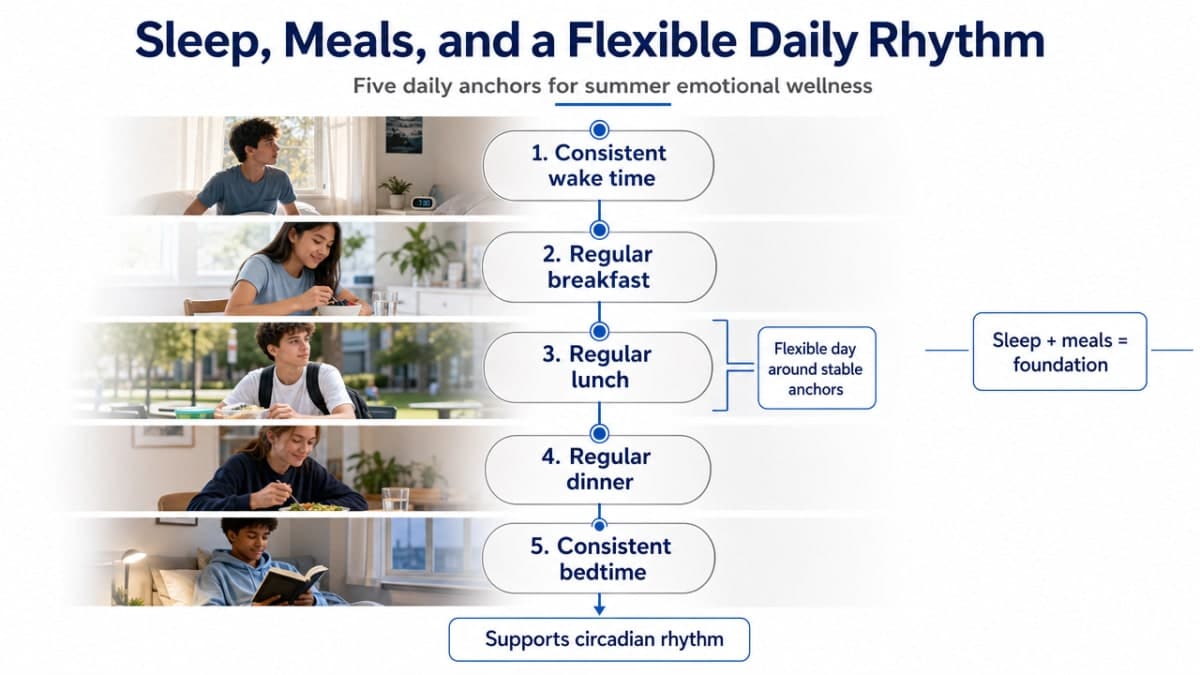
Start with the two anchors that move everything else: sleep and meals. University of Utah Health’s 2026 guidance for families points to consistent wake times, consistent bedtimes, and regular meals as the foundation of summer emotional wellness, even when the rest of the day stays flexible 1. A teen who’s allowed to drift into a 3 a.m. bedtime and a 1 p.m. wake-up will feel worse by August than they did in June. Not because they’re lazy. Because their body is doing exactly what bodies do when the circadian rhythm collapses.
From there, build outward gently. The CDC recommends at least 60 minutes of physical activity per day for children and adolescents, paired with reduced screen time and real social contact. A workable summer weekday might look like this: wake by 9, eat something real before noon, get one block of movement (a walk with the dog, the pool, a workout, a job that keeps them on their feet), one in-person social touchpoint, screens off during meals, and one shared family moment — dinner together, a show, a drive to the store. That’s it. Five anchors. Everything in between can stay loose.1,4
Connection, Movement, and Structured Programs
Movement and connection are the two levers that do the most work for the least argument. They’re also the two that disappear fastest when nobody plans for them.
You don’t need to sign your teen up for an elite sports camp. You need a reason for them to leave the house on most days and a reason for them to be around other humans their age. A part-time job at the grocery store counts. A volunteer shift at the animal shelter counts. A weekly pickup basketball game counts. A summer art class at the community college counts. The shape matters less than the consistency.
The research on structured summer programs is encouraging here. A 2024 systematic review found that well-designed summer holiday programs can improve mental health and social-emotional well-being in children and adolescents, with the strongest benefits showing up for kids who are already more vulnerable. That matches what the National Academies report describes — summer is a time of both risk and opportunity, and the deciding factor is often whether a young person has access to structured, supportive activity during those weeks.6.7
If formal programs aren’t realistic for your family, that’s okay. Build your own version. Pick two or three commitments your teen actually agrees to, and protect them on the calendar like you would a doctor’s appointment.
Talking With Your Teen Before Things Escalate
The hardest part of all of this isn’t the schedule. It’s the conversation.
The CDC’s guidance for parents of adolescents keeps coming back to one point: open, honest communication and shared time together do more for teen wellness than any specific tactic. That sounds simple. It isn’t. Talking to a teen who’s pulling away can feel like talking to a closed door.2
A few things that help. Talk sideways, not face-on. Conversations land better in the car, on a walk, while you’re both doing dishes — anywhere your teen doesn’t have to make eye contact. Ask specific questions instead of “how are you,” which gets you nothing. Try “what was the worst part of today” or “who did you actually talk to this week.” Listen longer than feels natural before you respond. And when you notice something — a mood shift, a new friend, a change in sleep — name it gently and once, without making it a confrontation.
University of Utah Health calls this “coping ahead”: talking through upcoming changes and stressors before they hit, so your teen knows you’re already on their team. You’re not interrogating. You’re staying close enough that when something does shift, they don’t have to climb a wall to tell you.1
When Home Strategies Aren’t Enough: Calling in Professional Help
What Professional Teen Treatment Actually Looks Like
You’ve tried the schedule. You’ve had the kitchen conversations. You’ve quietly counted the bottles in the cabinet. And something still isn’t shifting — or it’s getting worse.
That’s the moment a professional belongs in the picture. Not because you’ve failed. Because some of what your teen is carrying is bigger than what a family can solve at home, and that’s not a verdict on your parenting. It’s just where care belongs.
Here’s what professional teen treatment actually looks like, so you’re not calling into a black box. It starts with an assessment — a clinical conversation with your teen and usually with you, designed to understand what’s actually going on underneath the behaviors you’ve been seeing. That assessment matters because the same outward picture (withdrawn, irritable, sleeping oddly, maybe using) can come from different places, and the treatment plan depends on what’s driving it.8
From there, care is matched to severity. Outpatient counseling, where your teen comes in for sessions while living at home, fits many situations. When symptoms are more serious — daily substance use, safety concerns, a teen who can’t function in regular life right now — a higher level of care like residential treatment or partial hospitalization gives the structure and clinical support a household can’t provide alone. NIMH is clear that teen depression is highly treatable when evaluated and addressed by qualified professionals, and the same is true for substance use. Families are part of the work throughout, not on the outside of it.9,10
How Cenikor Supports Teens and Families Across Texas and New Mexico
Cenikor has been doing this work for nearly six decades as a nonprofit, with locations across Texas and New Mexico — Stephenville, Killeen, Waco, San Antonio, Farmington, San Marcos, Tyler, Corpus Christi, Amarillo, the DFW Metroplex, and Decatur — so families in our part of the country don’t have to drive across the state to find help that fits.
For teens, the continuum of care includes teen drug and alcohol rehab with detox when medically needed, residential treatment for kids who need a structured break from the environment they’ve been struggling in, partial hospitalization, outpatient services for teens who can stay at home while getting consistent support, and aftercare to keep the recovery going once the intensive phase ends. Because emotional struggles and substance use so often overlap in adolescents, the clinical approach addresses both rather than treating them separately.8
What happens when you call: a real person walks you through an initial conversation, helps coordinate an assessment, and explains what insurance covers — Cenikor works with more than 30 major carriers and was designated a Center of Excellence for substance use disorder by Evernorth Behavioral Health. You won’t be turned away because of cost alone. And you don’t have to know exactly what’s wrong with your teen before you reach out. That’s what the assessment is for.
Turning Summer From a Risk Window Into a Reset Window
Here’s the part worth holding onto. Summer doesn’t have to be the season you brace through. The same weeks that can let a struggling teen drift can also become the stretch where things actually get better — more sleep, real movement, a job they’re proud of, a conversation in the car that finally lands.
The research backs this up. Structured time, supportive adults, and access to meaningful activity can shift summer from a risk window into a reset window, especially for teens who were already stretched thin. You don’t need a perfect plan. You need a few anchors, your eyes open, and the willingness to call in help if the home version stops being enough.6,7
You’re already doing the hardest part by paying attention. Keep going. And if August arrives and something still isn’t right, that’s not failure — that’s the moment a professional steps in alongside you, and your teen doesn’t have to figure any of this out alone.
Your path to healing begins with a single call—reach out today to discover how our experienced team can help you reclaim your life and build the future you deserve.Frequently Asked Questions
Is summer break actually harder on teen mental health, or is that a myth?
It depends on the teen. A 2025 study found that depression and anxiety symptoms actually decreased for many adolescents during vacation compared to the school period. For others, losing the daily structure, peer contact, and adult check-ins that school provides makes existing struggles louder. Your job isn’t to assume — it’s to watch your specific kid.3
How do I tell the difference between normal teen moodiness and depression?
Normal moodiness comes and goes. Depression sticks. NIMH says the signal is feelings of sadness or irritability that don’t go away and start interfering with daily life at home, with friends, or with things your teen used to enjoy. Look for the cluster — persistent low mood plus sleep changes plus withdrawal plus loss of interest — lasting more than two weeks. Any mention of death or not wanting to be here is a same-day call.9
What are the early warning signs that my teen may be using alcohol or drugs over the summer?
SAMHSA points to a recognizable pattern: a new friend group your teen won’t introduce you to, secrecy about where they’re going, missing money or alcohol, bloodshot eyes, unfamiliar smells, dropped commitments, and unexplained mood or energy shifts. One sign alone may be nothing. Several together — especially with emotional changes — deserve a direct conversation and likely a professional assessment.10
How much structure should a teen really have during summer break?
Less than school, more than nothing. Aim for a few anchors: consistent sleep and wake times, regular meals, at least 60 minutes of physical activity a day, one in-person social touchpoint, and one shared family moment. Everything between those anchors can stay flexible. You’re not recreating a classroom — you’re keeping the body regulated and the lights on inside.1,4
When should I stop trying home strategies and call a professional?
Call when the pattern doesn’t shift after a few weeks of consistent home support, when symptoms are interfering with daily life, when substance use is on the table, or when your teen mentions hopelessness or thoughts of death — that last one is immediate. You don’t need a diagnosis before you reach out. An assessment is how you find out what’s actually going on. Calling sooner is better than waiting it out.9,10
What happens when a family contacts Cenikor about a struggling teen?
A real person walks you through an initial conversation, helps coordinate a clinical assessment for your teen, and explains what insurance covers — Cenikor works with more than 30 major carriers as a nonprofit. From there, care is matched to what your teen actually needs: outpatient, partial hospitalization, residential teen treatment, detox if medically necessary, and aftercare. Because emotional struggles and substance use often overlap in adolescents, both are addressed together.8
References
- How Summer Break Can Affect Your Child’s Mental Health. https://healthcare.utah.edu/healthfeed/2026/05/how-summer-break-can-affect-your-childs-mental-health
- Mental Health | Adolescent and School Health. https://www.cdc.gov/healthy-youth/mental-health/index.html
- Examining the effects of school-vacation transitions on depression and anxiety in adolescents. https://pubmed.ncbi.nlm.nih.gov/39819964/
- Summer and Health | Physical Education and Physical Activity. https://www.cdc.gov/physical-activity-education/staying-healthy/summer.html
- The impact of school absence on mental health in children and adolescents: evidence from a longitudinal study. https://pmc.ncbi.nlm.nih.gov/articles/PMC12803469/
- Effect of Summer Holiday Programs on Children’s Mental Health and Social–Emotional Well-Being: A Systematic Review. https://pmc.ncbi.nlm.nih.gov/articles/PMC11352663/
- The Effects of Summertime Experiences on Children’s Development. https://www.ncbi.nlm.nih.gov/books/NBK552668/
- Co-Occurring Disorders and Health Conditions. https://nida.nih.gov/research-topics/co-occurring-disorders-health-conditions
- Teen Depression. https://www.nimh.nih.gov/health/publications/teen-depression
- Alcohol, Tobacco, and Other Drugs: Resources. https://www.samhsa.gov/find-help/atod
Recovery Built for Real Life
Recovery doesn't have to feel out of reach. At Cenikor, we provide practical, affordable care designed for real life—whether you're navigating substance use, supporting a loved one, or helping someone find the right level of care.
Explore Your Options Written by Cenikor’s Clinical & Compliance Team